The war in Iran has entered its fourth week. Oil is at $112 per barrel. And three new developments have fundamentally altered the risk calculus for the US economy, the dollar, and American dominance in the Middle East.
Here is what changed—and why it matters.
1.The Supreme Court Just Removed the “Pay-For” from the $1.5 Trillion Defense Budget
On February 19, 2026, the Supreme Court ruled 6–3 that President Trump’s tariffs under the International Emergency Economic Powers Act (IEEPA) were illegal . The Court held that tariffs are taxes, and under the Constitution, only Congress has taxing authority.
The fiscal math just broke.
President Trump had justified the $1.5 trillion 2027 defense budget—a $600 billion increase over the 2026 baseline—by claiming tariff revenue would pay for it . The President himself acknowledged that *without* tariff revenue, the 2027 military budget should be limited to $1 trillion .
Now add the $200 billion supplemental request for the current Iran war operations
Total new defense-related spending: ~$800 billion in new obligations over 2026–2027.
The Committee for a Responsible Federal Budget estimates that sustaining a $1.5 trillion defense budget through 2035 would add $5.8 trillion to the national debt, including interest .
The funding source is gone. The spending remains. The Treasury must borrow.
2.Yemen Is About to Become the Second Front—and the Red Sea Is the Second Bottleneck
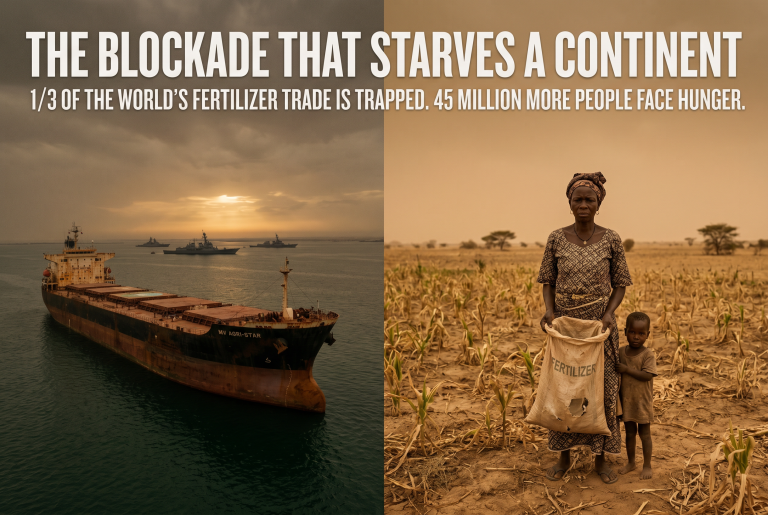
Iran’s Islamic Revolutionary Guard Corps Navy claims “complete control” of the Strait of Hormuz, through which 20% of the world’s oil supply passes .
But the Houthis—the Iranian-backed militant group that controls Yemen’s capital and hundreds of miles of Red Sea coastline—have not yet entered the conflict. That may change. Their leadership has stated plainly: “Our fingers are on the trigger” .
If the Houthis join, here is what happens:
-Saudi Arabia’s western oil infrastructure becomes a target. The kingdom’s pipelines run to the Red Sea port of Yanbu—passing through hundreds of miles of Houthi-controlled coastline .
– The Bab el-Mandeb Strait closes. This chokepoint links the Red Sea to the Gulf of Aden. Closure would force shipping around the Cape of Good Hope, adding weeks to transit times and spiking shipping and insurance costs.
– Egypt andthe Suez Canal are pulled in. The Suez Canal Authority loses toll revenue. Egypt faces economic pressure in a region already destabilized .
We are looking at both major oil chokepoints—Hormuz and Bab el-Mandeb—effectively closed simultaneously. That has not happened in modern history.
3.The Dollar’s “Machinery Moat” Is Eroding Just When the US Needs It Most
The petrodollar system was built on a simple mechanical necessity: Gulf producers needed dollars to buy American oil equipment and American weapons .
That is changing.
– Saudi imports from the US have dropped to ~8% of total imports—less than two-thirds of what they were a decade ago .
– Gulf sovereign wealth funds are pivoting from US Treasuries to domestic infrastructure, AI, and non-Western military procurement .
– Iran has reportedly proposed allowing tankers through Hormuz only if oil is traded in Chinese yuan—a direct attack on dollar settlement .
UBS Chief Economist Paul Donovan notes: “The functional requirement to hold greenbacks for trade settlement is diminishing” .
Add the fiscal pressure from the defense budget, and you get a dangerous combination: the US needs to borrow more, but the traditional buyers of US debt are reallocating capital at the very moment demand for dollars is being structurally challenged.
What This Means for US Dominance and the Global Economy
First: Inflation is no longer transitory—it’s structural.
Brent crude at $112 is the headline number. The real story is the physical market: Oman crude exceeded $162 per barrel; Murban topped $145; jet fuel surpassed $200 . Refiners in Asia are paying massive premiums to secure any available supply.
The International Energy Agency has called this the “biggest-ever oil supply disruption” .
Goldman Sachs and Citigroup warn that if the conflict continues, oil futures could breach the all-time high of $147.50 set in 2008 .
Second: The US has exhausted its policy tools to contain prices.
Treasury Secretary Scott Bessent has floated releasing more strategic reserves and even temporarily waiving sanctions on Iranian oil in transit . These are acts of desperation, not confidence.
As Christof Ruhl, former BP economist, told Bloomberg: “The US has almost exhausted the arsenal for stopping prices from rising… there isn’t much they can do” .
Third: The Suez parallel is real—but not in the way most think.
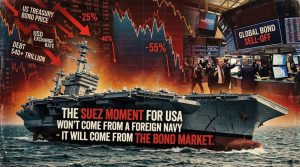
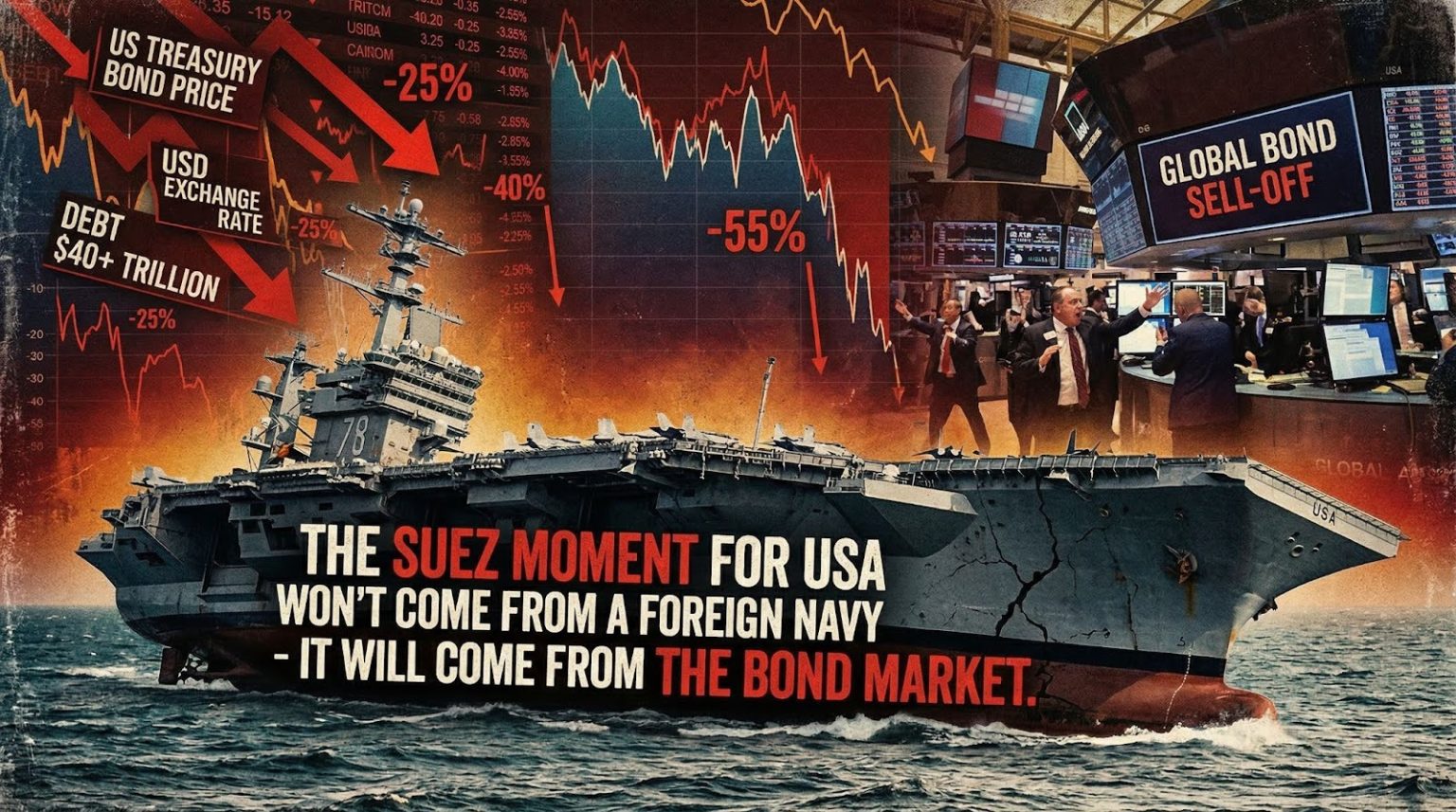
The Suez Crisis of 1956 marked the end of British dominance because the *United States* forced Britain to withdraw by threatening to sell its sterling bonds
The 2026 crisis will mark the end of *US dominance* if the bond market forces a reckoning—not because a foreign power applies pressure, but because the US can no longer borrow affordably to finance its own war.
The Bottom Line
The combination is unprecedented:
– A $1.5 trillion defense budget with its funding source invalidated by the Supreme Court
– A $200 billion supplemental for the current war
– Both major oil chokepoints threatened with closure
– A structural shift in petrodollar recycling
– Physical oil prices decoupling from futures, signaling genuine scarcity
If the Houthis enter the conflict—and Saudi oil infrastructure in the west is targeted—oil prices will not stay at $112. They will approach $150, then $200. Inflation will accelerate. Bond yields will spike. And the Treasury will face a buyers’ strike.
The United States will not be forced to withdraw from the Middle East by a foreign navy, as Britain was in 1956.
It will be forced to *choose* between financing its war and financing its government—and the bond market will make that choice for it.
That is how dominance ends. Not with a bang, but with a failed auction.
Your Thoughts?