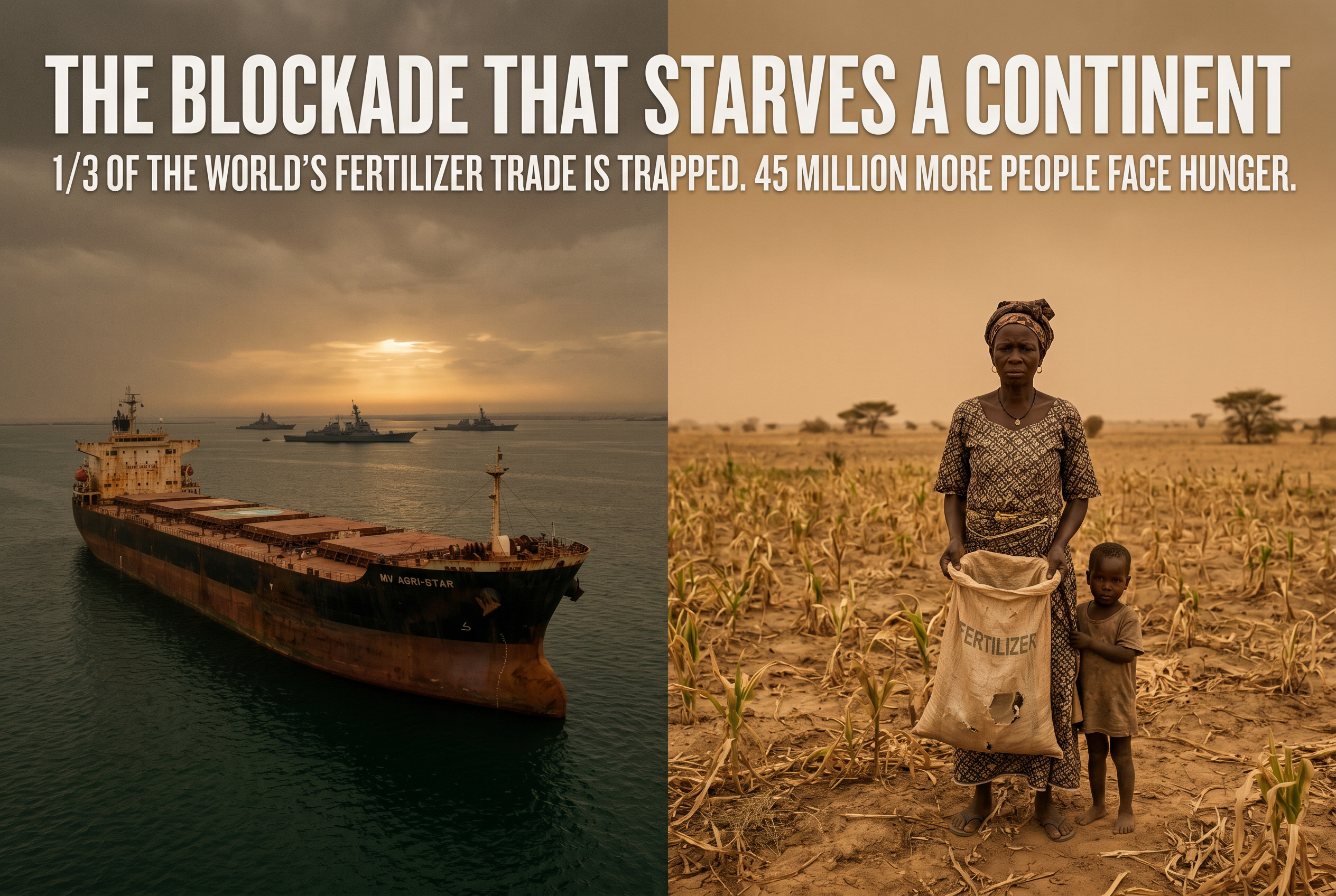
137 days into a war nobody voted for, one-third of the world’s seaborne fertilizer trade is trapped behind a blockade — and the poorest farmers on Earth will pay with their harvests, and their children’s lives
For over two years my team and I have documented the human cost of war — the children of Gaza, the war in Iran, the forgotten of the war in the Caribbean. Today I want to talk about a weapon that never appears in the Pentagon’s briefings: hunger. Because the war that the United States and Israel launched against Iran on February 28, 2026 is not only killing people with bombs. It is quietly preparing to kill millions more with empty plates, thousands of miles from the battlefield, in villages that could not find Tehran on a map.
As I write this, on July 15, 2026, the war has been grinding on for 137 days. The Strait of Hormuz — first closed by Iran in retaliation for the February 28 attacks, then sealed further by an American naval blockade — remains effectively shut to commercial fertilizer traffic. A fragile ceasefire has technically failed and control of the strait remains one of the core unresolved disputes, and shipping traffic is still minimal. The men who started this war will never miss a meal because of it. The same cannot be said for a farmer in Malawi, a mother in the Sahel, or a rice grower in South Asia.
The chokepoint nobody talks about
We hear endlessly about oil. But the Strait of Hormuz is also the artery of the world’s food system. According to the United Nations, roughly one-third of the entire global seaborne fertilizer trade passes through this single waterway. The IFPRI calculates that the closure has blocked around 21 million metric tons of annual urea export capacity from the Gulf region alone. NPR reports that the shutdown has bottled up close to half of the world’s urea exports — the most common nitrogen fertilizer on Earth. The region also supplies roughly a quarter of global ammonia trade and nearly half the world’s sulfur, the feedstock for phosphate fertilizer.
The market response was immediate and brutal. Granular urea out of Egypt — the global bellwether — jumped from roughly $400–490 per metric ton before the war to around $700. The World Bank recorded a 46 percent month-on-month spike in urea prices between February and March, and its Commodity Markets Outlook now projects fertilizer prices will rise 31 percent on average in 2026 — the worst affordability crisis since the Russia–Ukraine shock of 2022. By spring, fertilizer prices were running roughly 80 percent higher year-on-year.
Fertilizer is not a luxury good. It is the difference between a harvest and a failure. Norman Borlaug’s green revolution fed billions with synthetic nitrogen. Take it away, and the mathematics of hunger reassert themselves with terrifying speed.
Africa and Asia: the collateral damage
The countries most exposed to this shock are precisely the ones with the least responsibility for the war. FAO data reported by Forbes Africa shows how deeply the continent depends on Gulf fertilizer: Malawi imports 57 percent of its fertilizer from the region, Namibia 53 percent, Uganda and South Africa 51 percent, Madagascar 45 percent, Kenya 38 percent.
And the timing could not be crueler. The FAO’s Director-General warned in Rome this month that a delay of even a few weeks forces farmers to reduce fertilizer application or abandon it altogether — and that the damage is transmitted forward into the next harvests, tightening food supplies through the second half of 2026 and into 2027. The Sahel’s main planting season runs June through August — right now — overlapping with the lean season, when household food stocks are already exhausted. Southern Africa’s planting window opens in October–December; if affordable fertilizer has not returned by then, an entire second growing season is lost. The World Bank warns that rice output in South Asia, Southern Africa and parts of East Asia could fall by 20 to 50 percent. There is no need to speculate about the weather; the farming calendar alone tells us the catastrophe is already locked in.
The numbers of a preventable atrocity
Consider where the world already stood before this shock hit. According to IPC data, 318 million people across 68 countries face crisis-level hunger in 2026 — Nigeria alone accounts for 27.2 million, the Democratic Republic of Congo 26.7 million. For the first time this century, two famines are running simultaneously, in Gaza and Sudan — both, I will note, man-made. The World Bank reports that nearly 52.9 million people are projected to be acutely food insecure in West and Central Africa during this very June–August lean season, with more than 87 million facing hunger in East and Southern Africa.
Onto this tinderbox, the war throws a torch. The World Food Program estimates the conflict could push 45 million additional people into acute hunger. Forty-five million human beings — for a war of choice.
And who will catch them when they fall? No one. Because the United States spent 2025 dismantling USAID, once the backbone of global food and health assistance. A study published in The Lancet in June 2025 projected that the elimination of USAID funding could result in more than 14 million additional deaths by 2030, including over 4.5 million children under five. The safety net was burned before the fire started.
Hunger does not stay where it is born
History teaches us what comes next. The food price spikes of 2007–08 triggered riots in dozens of countries. The 2010–11 spike helped ignite the Arab Spring and toppled four governments. People who cannot feed their children do not sit quietly and starve — they move. They walk to the coast, they hand their savings to smugglers, and they board boats for Europe. The Mediterranean graveyard will fill again, and the same European leaders who cheered this war will wring their hands about “migration crises” of their own making. You cannot bomb a region’s food supply and blockade its fertilizer and then act surprised when desperate humanity arrives at your shores.
What must happen
Open the strait. End the war. Restore emergency fertilizer financing for import-dependent nations — the African Development Bank’s Emergency Food Production Facility and the Africa Fertilizer and Soil Health initiative point the way, but they cannot substitute for peace. And hold accountable the war profiteers who treat famine as an acceptable externality. Every projection in this article carries uncertainty — that is the nature of forecasts. But the direction is not uncertain. We are watching, in real time and with full documentation, the construction of a famine. No one will be able to say they did not know.
Peace now. Forever peace, now.
By Vahid Razavi — ForeverPeaceNow.com | ParentsPlea.com | Author of The Age of Nepotism, Ethics in Tech and Lack Thereof and the forthcoming NO ETHICS IN BIG TECH (releasing Hiroshima Day, August 6, 2026)
Sources
- CNBC — Fertilizer prices surge amid Iran war (Mar 25, 2026): https://www.cnbc.com/2026/03/25/fertilizer-price-iran-war-food-security-inflation-urea-potash-nitrogen-farmers.html
- NPR — War with Iran disrupts fertilizer exports (Mar 26, 2026): https://www.npr.org/2026/03/26/g-s1-115240/iran-war-strait-hormuz-fertilizer-exports-farmers-planting-season
- IFPRI — How fertilizer policies could exacerbate Hormuz price shocks (May 2026): https://www.ifpri.org/blog/how-fertilizer-policies-could-exacerbate-hormuz-price-shocks/
- World Bank Food & Nutrition Security Update #121 (Mar 27, 2026): https://thedocs.worldbank.org/en/doc/40ebbf38f5a6b68bfc11e5273e1405d4-0090012022/related/Food-and-Nutrition-Security-Update-121-March-27-2026v2.pdf
- World Bank Food & Nutrition Security Update #122 (May 29, 2026): https://thedocs.worldbank.org/en/doc/40ebbf38f5a6b68bfc11e5273e1405d4-0090012022/related/Food-and-Nutrition-Security-Update-122-May-29-2026.pdf
- FAO — Fertilizer scarcity will affect next harvests, DG warns (Jul 2026): https://www.fao.org/newsroom/detail/strait-of-hormuz-crisis–fertilizer-scarcity-will-affect-next-harvests-and-food-supplies–fao-warns/en
- Forbes Africa — Africa’s Fertilizer Crisis (May 29, 2026): https://www.forbesafrica.com/current-affairs/2026/05/29/africas-fertilizer-crisis-threatening-regional-food-security
- Middle East Institute — From Hormuz to the Sahel (May 2026): https://mei.edu/publication/from-hormuz-to-the-sahel-a-fertilizer-shock-and-a-maghreb-solution/
- African Agribusiness / IPC — 318 million in crisis-level hunger (Apr 2026): https://africanagribusiness.com/318-million-people-face-crisis-level-hunger-in-2026-across-68-countries/5667/
- AfDB / Al Jazeera — African governments must act on fertiliser shortages (Apr 2026): https://www.afdb.org/en/news-and-events/african-governments-need-take-urgent-action-fertiliser-shortages-92779
- GIS Reports — Iran war squeezes critical supplies (Jun 5, 2026): https://www.gisreportsonline.com/r/iran-war-strains/
- foodfacts.org — Inside the 2026 food crisis: https://www.foodfacts.org/articles/global-food-crisis-2026
- The Lancet — Projected effects of USAID defunding (Jun 2025): https://www.thelancet.com/journals/lancet/article/PIIS0140-6736(25)01186-9/fulltext