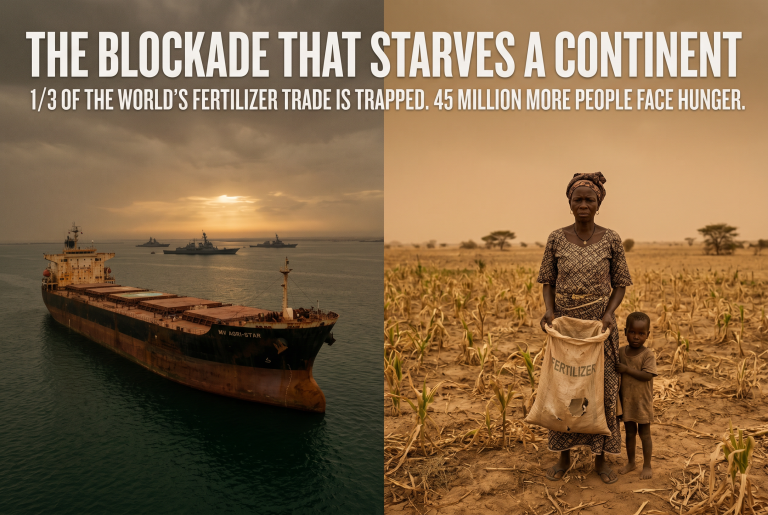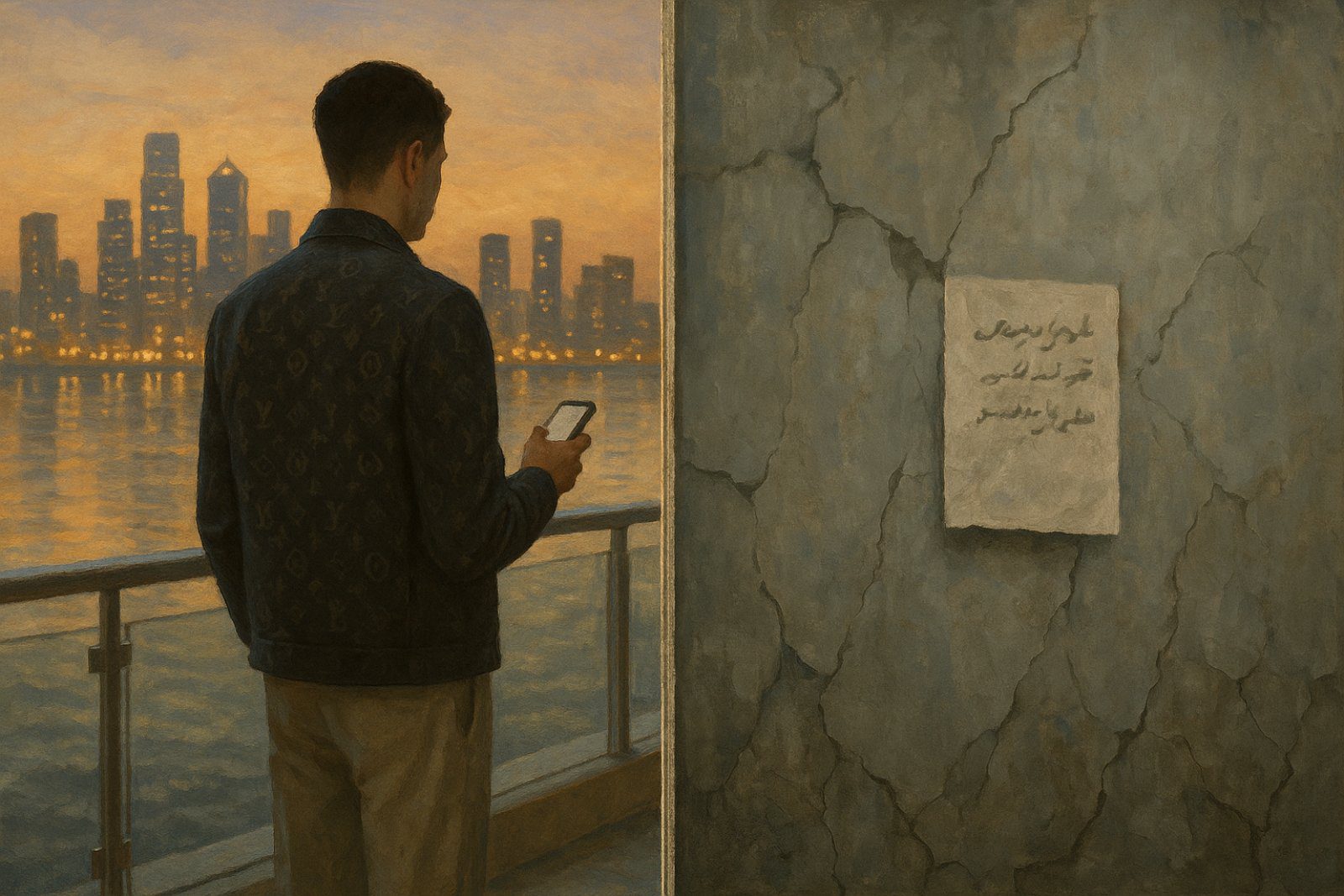
Two children of the same country
I was born in Tehran in 1975. My mother was a nurse. My father was an engineer. We were a middle-class family, the kind of family that every economy depends on and every sanctions policy pretends not to see. In 1986, in the middle of the Iran-Iraq war, my mother and I left on a visa because my parents wanted their child to live.
Forty years later, I want to tell you about two kinds of Iranian children.
The first kind is called aghazadeh — the children of the ruling class. They grew up in the same country I did, but they grew up on the other side of the rope line. Today many of them live in Canada, the United States, London, Europe and Dubai, in apartments bought with money that left Iran through sanctions-busting middlemen, shell companies and foreign bank accounts. Their parents chant “Death to America” on Friday. Their children post from the beach on Saturday.
The second kind is the child of the nurse and the engineer who stayed. That child is watching food prices more than double in a single year. That child’s grandmother cannot find her insulin, or can find it at six times last year’s price. That child’s father may be a man who has taped a handwritten notice to a hospital wall with his blood type and a phone number, because his kidney is the last thing he owns that the inflation has not eaten.
Both children are Iranian. Only one of them is being punished by the sanctions that Washington, London and Brussels say are aimed at the regime. I want you to sit with that, because this article is about why that is not an accident. It is about why economic sanctions, as practiced against Iran for more than four decades, do not topple the powerful. They feed them. And it is about why I, as an Iranian-American who has no love for the men ruling Tehran, am against collective punishment in every form.
Sixty years of sanctions, zero regimes toppled
Let me begin with the record, because the record is what the sanctions industry never wants to discuss.
Cuba. Washington formalized its embargo on Cuba in 1962. The Castro brothers held power through a dozen American presidents, from Eisenhower to Trump’s first term. Fidel died in 2016 at 90. The Communist Party still rules Havana. Sixty-four years of embargo produced shortages, blackouts and a diaspora — not a change of government.
Iraq. After 1991 the United Nations imposed one of the most comprehensive sanctions regimes in modern history. Iraq’s professional middle class was hollowed out. Meanwhile the UN-backed Volcker inquiry later found that Saddam Hussein’s government pocketed about $1.8 billion in kickbacks and surcharges from the Oil-for-Food program alone, and roughly $11 billion more from smuggled oil. Saddam was never removed by sanctions. He was removed by an invasion that cost hundreds of thousands of lives and gave the world ISIS.
Venezuela. Washington piled financial and oil sanctions on Caracas from 2017 onward. Nicolás Maduro did not fall. He was seized by American forces in a military raid on January 3, 2026. And then something telling happened: the United States did not hand power to the opposition. It went into business with Maduro’s own vice president, Delcy Rodríguez, and in April 2026 lifted the sanctions on her personally. The sanctions did not change the system. They simply decided which insider would get the keys.
Iran. Washington has sanctioned Iran in one form or another since 1979. In 2019 the US Treasury personally sanctioned Mojtaba Khamenei, the Supreme Leader’s son. In February 2026 his father was killed in the US-Israeli strikes. In March 2026 the Assembly of Experts named Mojtaba the new Supreme Leader. Read that again. A revolution that overthrew a hereditary monarch in 1979 now passes the crown from father to son, and the son was already on the American sanctions list. If you want to understand the age of nepotism, start there.
South Africa is the one case people point to, and I take it seriously. Sanctions helped isolate the apartheid state in the 1980s, including the US Comprehensive Anti-Apartheid Act passed over President Reagan’s veto in 1986. But notice what made it different. The people living under apartheid asked for sanctions, through their own liberation movement, the African National Congress. The pressure was global, it targeted a minority regime’s access to capital, and it was paired with a mass movement inside the country that was already winning. Historians still argue about how much of the credit the sanctions deserve. What no one argues is that the Black majority chose that sacrifice for themselves. Nobody asked Iran’s nurses, engineers, pensioners and kidney patients.
The strongest case for sanctions on Iran is not regime change. It is leverage: defenders argue that sanctions brought Tehran to the table for the 2015 nuclear deal and starve the military of money. But the deal was a negotiation, not a revolution, and Washington tore it up in 2018. As for starving the military, I will show you below where the pain actually lands. It does not land in the barracks. It lands in the pharmacy.
The aghazadeh: a nation’s wealth in a foreign postcode
Every Iranian knows the word. Aghazadeh — the child of the master. The son or daughter whose surname opens doors, closes investigations and, when the money is ready to move, secures the visa.
The numbers come from inside the regime itself. In 2018 Mahmoud Bahmani, a former governor of Iran’s central bank, claimed that more than 5,000 children of well-connected families were living abroad and holding some $148 billion in foreign accounts. In 2020 Mohammad Gharazi, a former minister, cited 5,000 descendants of senior officials living outside Iran. In 2022 Morteza Mirian, a Revolutionary Guards ground-forces commander, said on state television that close to 4,000 children of officials were living in the United States, Europe and Canada, and that they should never be given responsibility for Iran’s future. None of these figures has been independently verified. I cite them because they are the regime’s own admissions.
The names are not secret either. In September 2022, one day after President Ebrahim Raisi warned his officials to stop their children from emigrating, activists revealed that his vice president Ensieh Khazali’s son had been living in Canada for years. In January 2026, while security forces were crushing protests at home, Iranian-Americans launched petitions to deport Eissa Hashemi, son of former vice president Masoumeh Ebtekar, and Fatemeh Ardeshir-Larijani, daughter of Ali Larijani, then secretary of the Supreme National Security Council.
The most honest admission came from Mohammad Bagher Nobakht, spokesman for Hassan Rouhani’s government, who listed getting around sanctions as one of the reasons officials’ children live abroad. Sit with that. The sanctioned government’s own spokesman described its children overseas as part of the sanctions-busting machinery. A sanctions wall that works like that is not a wall. It is a filter. It lets through the people with connections and stops everyone else.
Canada, to its credit, banned senior Iranian officials in 2022, covering anyone who served the regime since 2003. Its border agency has opened 181 investigations and identified 37 suspected senior officials. It has struggled to remove them. Former deputy interior minister Salman Samani was finally deported in August 2026, four years after the ban. Revoking a few thousand visas costs a Western government almost nothing. Hunger for ninety million people costs everything to people who never had a say.
The middlemen: how sanctions privatize a nation’s oil
Every sanctioned barrel still finds a buyer. Sanctions do not decide whether Iran sells its oil, steel and petrochemicals. They decide who gets to stand in the middle and take a cut.
Meet Babak Zanjani. During Mahmoud Ahmadinejad’s second term he was tasked with selling Iranian oil around international sanctions, through a web of dealers and front companies stretching across the UAE, Turkey and Malaysia. The money did not all come home. By official accounts he owed the state about $2.8 billion, and his assets abroad, in hotels, aviation and real estate, were estimated at $4 to $5 billion. He was arrested in 2013 and sentenced to death in 2016. President Rouhani himself warned that executing Zanjani could make it impossible to learn which officials had protected him. Those officials have never been named.
Here is how the story ends. In April 2024 Zanjani’s death sentence was commuted to 20 years, with the approval of the judiciary chief and the Supreme Leader. By 2025 he was back in business as the face of a conglomerate called Dot One, which won an $800 million government rail contract. In January and again in July 2026, Washington sanctioned him and his network for helping the regime move money. The sanctions-buster was jailed, pardoned, re-hired and re-sanctioned. Through every turn of that wheel, the people who paid were the ones who never saw the oil money in the first place.
Zanjani is not an exception. In 2022 an Iranian parliamentary report alleged roughly $3 billion in corruption at Mobarakeh Steel, the country’s largest steelmaker and itself on the US blacklist. The disclosures reached Friday prayer leaders and media outlets who had received the plant’s money, and the deputy head of the investigation called it the tip of the iceberg. In October 2025 Tasnim, a news agency close to the Revolutionary Guards, reported that about $95.6 billion in non-oil export earnings from 2018 to 2025, roughly 35 percent of the total, never returned to Iran’s official financial system. Iran’s largest non-oil exports are petrochemicals such as propane, methanol and bitumen. Some of that money is trapped by sanctions. Some of it is parked. Some of it is gone. No one outside the circle will ever know which.
This is what sanctions do to a country’s wealth. They take an economy that once moved through banks and contracts and push it into the shadows, where it moves through cousins, shell companies, brokers in Dubai and accounts in places with friendly property laws. In the West, an advocacy industry announces every new designation as a victory. In the East, refiners keep buying Iranian crude through intermediaries, and Washington’s own experts admit that truly choking that trade would mean taking on Beijing. The pressure stays tight enough to make the middleman rich and loose enough to keep the regime afloat.
I do not believe the people who design these policies are naïve. A policy that produces the same outcome for forty-seven years is not failing. It is working for someone.
Who actually pays: the nurse, the engineer and the pensioner
When I was a boy in Tehran, an engineer’s salary and a nurse’s salary bought a middle-class life, even in wartime. That family is disappearing from Iran. A retired labor activist from General Steel described it plainly: families slid from roughly middle class, to poor, to absolutely poor. According to state-affiliated media cited by CNN, the real value of Iran’s base wage fell from about $232 a month to $83 over the past decade.
Now look at prices. Iran’s Statistical Center reported that by July 2026 prices were 87.9 percent higher than a year earlier. For the two poorest tenths of households, the figure was around 100 percent. Food rose 129 percent in twelve months. In rural Iran, where food fills most of the basket, prices more than doubled. France 24 reported in October that year-on-year inflation hit nearly 90 percent in September, with food prices more than doubling. Depending on how you measure it, inflation is running between 60 and 90 percent, and above 100 percent for the poor. The jobs went with it: about 450,000 fewer people employed this spring than last, and more than 1.3 million full-time jobs gone.
The currency tells the same story in one number. When the nuclear deal was signed in 2015, a dollar bought about 32,000 rials. In late September 2026 it bought more than 2.5 million. A family’s savings lost nearly 99 percent of their value against the dollar in eleven years. The aghazadeh, whose money sits in dollars, pounds and dirhams, lost nothing.
Then there is medicine. Al Jazeera reported in September 2026 that about 800 pharmaceutical products were in short supply across Iran, 90 of them essential and life-saving. Acetaminophen was up 375 percent in a year, amoxicillin 285 percent, and insulin cost up to six times what it did a year earlier. Pharmacies in south Tehran had run out of infant formula. Part of this is the war itself: some 44 pharmaceutical and medical-equipment companies were damaged or destroyed. But the same reporting is clear that years of “maximum pressure” had already crippled the banking and shipping channels Iran needs to import medicine, humanitarian exemptions or not.
That is the lie at the center of the humanitarian exemption. Medicine is not sanctioned. Paying for it is. Human Rights Watch documented in 2019 how banks and suppliers refuse legal humanitarian trade out of fear. A Swedish company stopped selling the special dressings that children with epidermolysis bullosa, a disease that makes skin blister and tear, need to survive. An Iranian legal group says nearly 30 of those patients, mostly children, died after the dressings stopped coming. One of them was a baby girl named Zeynab from Ahvaz. I will not give you a total death count from medicine shortages, because no one has counted honestly and I refuse to invent one. What I can tell you is that each of these deaths has a name, and none of them was an aghazadeh.
And then there are the kidneys. Iran has had a paid kidney market for decades, and handwritten ads near transplant hospitals are not new. What has changed is how many people are selling and why. Iran International found sellers as young as 16, with kidneys priced at roughly $5,000 to $10,000. Radio Farda’s review of organ ads this fall found debt to be the most common reason given, including a 34-year-old man in Zahedan posting an urgent sale “due to financial problems.” When a country’s young men price their own organs to pay off debts, the sanctions have reached their target. It just was never the target we were told about.
Punish the thieves, not the nation
Let me be clear about where I stand. I have no sympathy for the men who rule Iran. They execute protesters, they crushed the uprising of January 2026, and their children launder the proceeds of a stolen country through Western real estate. I want them held accountable.
But it is one thing to ban the elite from getting visas and to stop them exporting hundreds of millions of dollars of a nation’s wealth. It is another thing entirely to punish ninety million people for the crimes of a few thousand. I am against collective punishment. Article 33 of the Fourth Geneva Convention prohibits collective penalties against protected civilians. Sanctions lawyers will tell you that article was written for occupied territory, not for banking rules. I am not a lawyer. But I know what it means when an entire nation is made to pay for the crimes of the men who rule it.
Some Iranians in the diaspora, people I know and respect, support maximum pressure because they believe it will finally bring the regime down. I understand that anger. I share it. But forty-seven years of evidence says broad sanctions do not bring the regime down. They bring the middle class down, and they hand the regime both an enemy to blame and a monopoly on the smuggling routes.
Here is what real accountability would look like:
- Visa bans that actually bite. Officials, Revolutionary Guards commanders and their immediate families barred and removed, not 181 investigations and two deportations in four years.
- Follow the money. Trace, freeze and hold in trust the condos, companies and accounts tied to regime insiders in Canada, Britain, the UAE, Turkey and Malaysia, for the Iranian people, not the regime.
- Shut down the middleman economy. Public beneficial-ownership registries, and prosecution of the banks, brokers and shipping firms in the West and the Gulf that profit from evasion.
- A humanitarian channel that works. Designated banks with written government guarantees, so insulin, cancer drugs, infant formula and vaccines move without the over-compliance that cut EB children off from their dressings.
- Lift the sector-wide sanctions and the blockade on civilian goods. Food, medicine and the inputs to make them should never be a weapon.
- Name the abusers. Human-rights sanctions on the individuals who order executions and crackdowns, published by name, enforced across borders.
None of this is soft on the regime. It is the only approach that is hard on the regime, because it goes after the one thing the aghazadeh care about: their money and their safe harbor.
Two children, one choice
I started with two Iranian children. One is posting living off stolen wealth of a nation by his father in another country, living on money that left Iran through a middleman’s account. The other is standing in a pharmacy in south Tehran, holding a prescription the pharmacist cannot fill.
Every round of broad sanctions is a choice between them. Washington, London, Ottawa and Brussels keep telling us they are choosing to punish the first child’s parents. Forty-seven years of results say they are choosing to punish the second child, while the first one’s visa stays valid and the sons of the powerful inherit the country.
My mother spent her Fridays in hospital corridors during the Iran-Iraq war, caring for people whose lives had been broken by decisions made far away. I think about the nurses in those same corridors today, rationing insulin and searching for antibiotics. They did not choose their rulers. They should not be made to pay for them.
Target the thieves. Free the medicine. End the war. Stop punishing a nation for the crimes of the men who stole it.
Peace now. Forever peace, now.
By Vahid Razavi — ForeverPeaceNow.com | ParentsPlea.com | Author of The Age of Nepotism, Ethics in Tech and Lack Thereof and NO ETHICS IN BIG TECH
Sources
NIAC
- NIAC Insights — Inflation at 66 Percent, Half a Million Fewer Jobs (2026): insights.niacouncil.org
- NIAC — Sanctions, Human Rights, and the Everyday Struggle of Iranians: niacouncil.org
Iran International
- Iranian Official Slams 4,000 Senior Colleagues Whose Families Live Abroad (Aug 6, 2022): iranintl.com
- Emigration of VP’s Son to Canada Stirs Controversy in Iran (Sep 10, 2022): iranintl.com
- Iranian-Americans call for deportation of officials’ relatives (Jan 16, 2026): iranintl.com
- Iranian Oil Tycoon Awaiting Execution for Embezzlement May Go Free (Feb 20, 2024): iranintl.com
- Iranian Oil Tycoon’s Death Sentence Commuted to 20 Years (Apr 30, 2024): iranintl.com
- US sanctions four people, nine entities linked to Iranian tycoon Babak Zanjani (Jul 24, 2026): iranintl.com
- Massive Corruption at Steel Plant Rocks Iran’s Political System (Aug 22, 2022): iranintl.com
- Large Corruption Case Puts Iran’s Hardliners in a Bind (Aug 30, 2022): iranintl.com
- Over $95 billion in export earnings not returned to Iran, report says (Oct 10, 2025): iranintl.com
- Children as Young as 16 in Iran Sell Kidneys Amid Poverty (Mar 28, 2024): iranintl.com
- From shadow to power: Who is Mojtaba Khamenei? (Persian, Mar 4, 2026): iranintl.com
Al Jazeera
- Medicine shortages grow in Iran as US tightens sanctions, blockade (Sep 9, 2026): aljazeera.com
- Iranians stock up on food and medicine as fears of new US fighting grow (Sep 29, 2026): aljazeera.com
- Iranians with rare disease dying under US sanctions (May 28, 2021): aljazeera.com
- Oil-for-food probe raps global firms (Oct 27, 2005): aljazeera.com
France 24
- ‘Going bankrupt’: Iran shopkeepers struggle as war dims demand (Oct 11, 2026): france24.com
TRT World
- US hits Iran military supply chain as fate of diplomatic talks remains uncertain (Sep 2026): trtworld.com
- Iranian traders, shopkeepers protest currency’s record fall (Dec 2025): trtworld.com
BBC
- BBC News — Iran commutes billionaire Babak Zanjani’s death sentence (Apr 30, 2024): bbc.co.uk
Additional sources
- Human Rights Watch — “Maximum Pressure”: US Economic Sanctions Harm Iranians’ Right to Health (Oct 29, 2019): ecoi.net
- Radio Farda — The hidden organ market in Iran (Persian, Sep 2026): radiofarda.com
- Global News — Iranian regime member deported from Canada, CBSA confirms (Aug 18, 2026): globalnews.ca
- NPR via WUSF — U.S. lifts sanctions on Venezuela’s acting President Delcy Rodríguez (Apr 2, 2026): wusf.org
- CNN — Iran war latest, Aug 25, 2026 (real base wage figures): cnn.com
- Article 18 — Iranian leaders sending their children abroad ‘troubling’ (2019, Bahmani claim): articleeighteen.com
- Al Arabiya Farsi — Officials’ children living abroad (Feb 14, 2024, Nobakht remark): farsi.alarabiya.net