By Vahid Razavi — ageofnepotism.com — September 2026
I was born in Tehran in 1975. When I was five, Iraq attacked Iran and I watched a war from the inside. My mother was a nurse; on Fridays I sat in hospitals full of refugees and wounded men. In 1986 my family got me out and brought me to America so that I would never have to see that again.
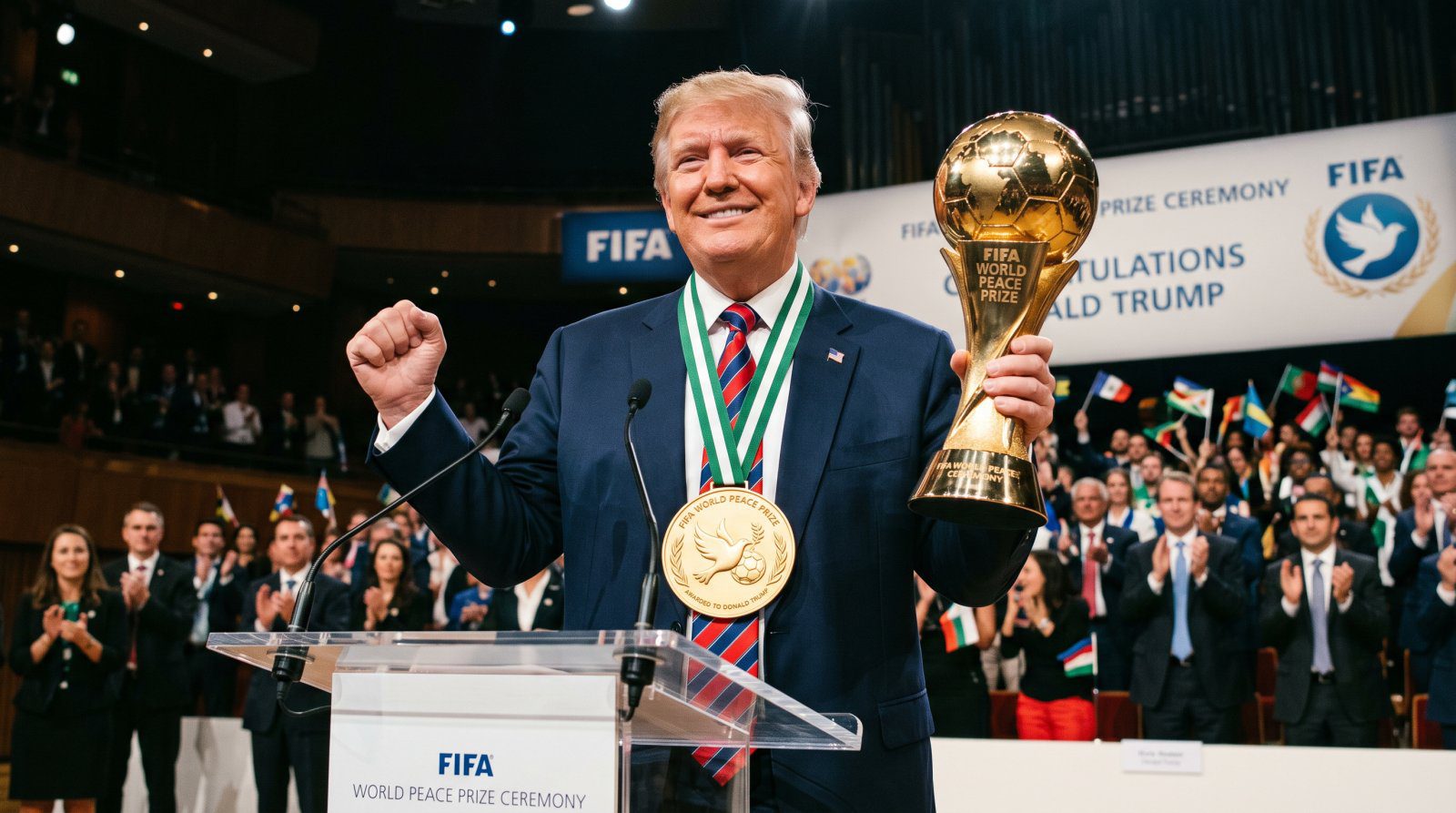
Forty years later, the country that took me in is bombing the country I left. The Supreme Leader I grew up under was killed in an airstrike on the first morning of Ramadan.[1] Bridges I have driven across are rubble. Universities I know by name have been hit.[1] And the man who ordered it wears a gold medal around his neck that says “Peace Prize.”[2]
I want to be precise about something, because precision is what these people fear. This is not a story about one bad president. It is a story about a spectrum. The United States did not wake up on February 28, 2026 and decide to go to war with Iran. It walked there, one rung at a time, on a ladder that was built under Biden and climbed under Trump. Sanctions became blockades. Blockades became boat bombings. Boat bombings became a raid on a capital city. The raid on a capital city became a regional war. And at every step, the administration found a new enemy, a new pretext, and a new ally to insult.
So let me lay out the ladder. I am going to define the rungs first, because the people who run this country count on you not knowing the vocabulary. Then I will go country by country, before Trump and after, and you can decide for yourself whether the man deserves a peace prize or a cell in The Hague.
Every fact, date, and figure in this piece has been checked against named news organizations, government records, and international bodies. I am posting the full source list — every one of them — as a comment below, so you can check my work yourselves.
Part One: The Vocabulary of Coercion
Soft war is the term I use for everything an empire does to break a country without formally declaring that it is breaking it. It has four blades: cyber attacks on infrastructure and communications; financial blockade — cutting a nation off from dollars, correspondent banks, Visa and Mastercard; legal isolation — indicting a foreign head of state, sanctioning the judges who might indict yours; and psychological isolation — the “make a deal before it’s too late” posts, the maps, the drones circling offshore. Soft war is designed to force submission while preserving deniability. It kills people. It just kills them slowly, in dialysis wards and dark maternity hospitals, where cameras do not go.
Economic war is soft war with the mask off: trade embargo, tariffs used as a weapon rather than a trade policy, and naval blockade — physically stopping ships. A blockade is, under the laws of war, an act of war.
Coercive diplomacy is a specific term with a specific meaning, coined by the political scientist Alexander George: the use of threats, or limited demonstrative force, to persuade an adversary to stop or undo something it is already doing — as distinct from brute force, which simply takes what it wants. Coercive diplomacy is “do this or else.” It works only when the target believes the “or else” is real. So the coercer has to keep proving it. That is why the threats always escalate.
Targeted and restrictive measures — the European Union’s own term for its sanctions — is the polite name for punishments aimed at specific people or classes of people rather than whole countries: asset freezes, visa bans, entry suspensions, deportations. When they are aimed at judges and UN rapporteurs, they are an attack on law. When they are aimed at migrants because of their religion, their passport, or the opinions they posted, they are an attack on human beings for who they are and what they think.
Active war is the top of the ladder: airstrikes, missile strikes, raids, the killing of heads of state and the kidnapping of others.
Hold those five rungs in your head. Now watch the United States climb them.
Part Two: The Biden Baseline — Nobody Should Pretend This Started in 2025
I criticized Joe Biden’s wars while he was waging them, so I am not going to sanitize him now. The Biden years were not peace. They were soft war and proxy war conducted by people who wore nicer suits.
Under Biden the United States armed Israel through the war in Gaza. Biden kept nearly all of Trump’s first-term “maximum pressure” sanctions on Iran in place.[3] He kept the Trump-era Title 42 border expulsion policy running for more than two years after taking office, using it to turn away well over a million people, before finally ending it in May 2023.[4] In June 2024 he signed his own asylum shutdown at the southern border, sealing it to most asylum seekers whenever daily crossings passed a threshold.[5] He launched retaliatory airstrikes on Iranian-backed militias in Iraq and Syria in February 2024 after a drone attack killed three American soldiers at Tower 22 in Jordan, hitting dozens of targets in five days.[6] He and the UK began bombing the Houthis in Yemen starting January 2024, a campaign that ran, on and off, into 2025.[7] He raised tariffs on Chinese electric vehicles to 100 percent in May 2024, quadrupling the existing rate, on top of tariffs and export controls he had already kept or expanded from Trump’s first term.[8] He eased Venezuelan oil sanctions in late 2023 and snapped them back in 2024 when Maduro would not behave.
One moment of genuine cooperation: in September 2023, Iran freed five American detainees — Siamak Namazi, Morad Tahbaz, Emad Shargi and two who remained anonymous — in a deal brokered by Qatar, in exchange for five Iranians held in US custody and the release of $6 billion in Iranian oil revenue that had been frozen in South Korea. Biden announced new sanctions on Iran’s intelligence ministry the same day he announced the swap.[9]
That was the baseline. Soft war, economic war, and proxy war — rungs one and two, with active war outsourced or kept limited. The Democrats built the ladder. The Republicans are simply climbing it faster, higher, and with a bigger flag.
Part Three: Country by Country — Before Trump, After Trump
Iran
Before Trump (Biden years): Sanctions maintained, enrichment left to fester after Washington abandoned the nuclear deal in Trump’s first term. A prisoner swap in 2023. Retaliatory strikes on Iranian-backed groups in Iraq and Syria in 2024. A UN “snapback” of sanctions in September 2025 collapsed the rial and froze Iranian assets abroad, and the Treasury Secretary called it the strategy’s “grand culmination.”[3]
After Trump (second term): Every rung of the ladder at once. On February 28, 2026, in the middle of nuclear negotiations and the first week of Ramadan, the United States and Israel launched “Operation Epic Fury.” The first strikes killed Ali Khamenei along with his daughter, son-in-law, grandchild and daughter-in-law. Cyberattacks blacked out Iran’s internet for more than sixty hours. Trump released a statement that the purpose was regime change.[1]
Then came the economic war on top of the shooting war. Iran closed the Strait of Hormuz; the United States imposed its own naval blockade of Iranian ports from April 13, 2026. When a ceasefire memorandum was finally signed in Islamabad on June 17 — Trump signed it over dinner at Versailles — it lasted three weeks. On July 8 Trump declared it “over.” The blockade was reinstated. On August 20 he announced “economic D-Day”: any nation trading with Iran would be sanctioned. On August 24 the Treasury Secretary unveiled “Operation Economic Outcast,” giving every country on earth a deadline to cut ties with Iran or be thrown out of the dollar system. On August 28 Treasury cut off the UAE branches of an Egyptian bank from dollar transactions for doing business with Iran.[1]
Count the cost. By the Pentagon’s own numbers, 18 US soldiers and one contractor killed, 757 wounded, 42 aircraft lost or damaged, and the Fifth Fleet base in Bahrain rendered inoperable. Iran reports 3,528 dead and 27,170 injured; the human rights group HRANA counts 3,684 killed, including 1,721 civilians; the UN’s humanitarian office puts civilian dead at more than 3,400. UNICEF reported 300 children killed in the first two weeks alone. The Iranian Red Crescent documented 65 schools and 32 medical facilities hit. A US strike collapsed the B1 bridge between Tehran and Karaj on the last day of Nowruz, with families gathered in the parks below; experts called it a possible war crime and the President celebrated it. The cost to the American taxpayer through June: $113.3 billion, while the administration asked Congress for a record $1.5 trillion Pentagon budget.[1]
And the psychological warfare. On April 7 Trump posted that “a whole civilization will die tonight, never to be brought back again.” Amnesty International’s Secretary General said the statement “may constitute a threat to commit genocide.”[1] I grew up in that civilization. I have family in it.
Venezuela
Before Trump: Sanctions, indictments, and pressure. The Southern District of New York indicted Maduro on narco-terrorism charges in 2020, in Trump’s first term. Biden negotiated limited oil sanctions relief in 2023, reimposed it in 2024, and recognized the opposition’s claim that Maduro stole the July 2024 election. That was the ceiling of Biden’s Venezuela policy: legal isolation and economic pressure.
After Trump: The ladder was climbed in four months. In September 2025 the US military began blowing up small boats in the Caribbean, claiming they carried drugs. The first strike, on September 1–2, killed nine people; two survivors clung to wreckage for 45 minutes before a second “double-tap” strike killed them too. Trump posted the first video. The second has never been released.[10] In December 2025 the US seized tankers carrying Venezuelan oil and declared a blockade on Venezuelan oil exports. On January 3, 2026, at two in the morning, “Operation Absolute Resolve” struck four Venezuelan states, shut off the power in Caracas, overran the air defenses, and Delta Force took Maduro and his wife Cilia Flores out of their home and flew them to the USS Iwo Jima and then to a Brooklyn jail. Between 23 and 47 Venezuelan soldiers were killed, along with 32 Cubans and at least two civilians, including a Colombian street vendor named Yohana Rodríguez Sierra.[11]
Call it what it is. A sitting head of state — however illegitimate his election — was taken by a foreign military and put in an American jail. Trump then announced the United States would “run the country.” Within weeks, Venezuelan officials agreed to hand over roughly $3 billion in “sanctioned oil” and to negotiate an energy deal.[12] I worked at Amazon Web Services; I know what an acquisition looks like. This was an acquisition. The military was the deal team.
One more irony, since I promised precision: María Corina Machado, the Venezuelan opposition leader, won the 2025 Nobel Peace Prize in October, weeks before the raid, “for her tireless work promoting democratic rights for the people of Venezuela.” She publicly dedicated the prize to Trump, thanking him “for his decisive support of our cause.”[13] I leave it to you to decide what that says about the prize, or about her.
Colombia — and the Fishermen
Before Trump: Colombia was America’s closest security partner in South America. Under Biden the relationship with Gustavo Petro, a leftist, was cool but correct.
After Trump: On September 15, 2025, the second US boat strike killed Alejandro Carranza, a Colombian fisherman and father of four. Petro called it “an extrajudicial execution.” Carranza’s family filed a complaint with the Inter-American Commission on Human Rights naming Defense Secretary Pete Hegseth.[14] Washington’s answer was to decertify Colombia as a drug-war partner in September 2025 — the first such move against Colombia since 1997, putting it alongside Venezuela, Bolivia, Afghanistan and Myanmar — and then, in October, to sanction Petro personally, along with his wife, his son, and his interior minister, freezing their US assets and placing the sitting president of Colombia on the same blacklist as the leaders of Russia and North Korea.[15] As of late August 2026, “Operation Southern Spear” has killed at least 227 people in at least 68 strikes on 69 vessels in the Caribbean and eastern Pacific, with 17 more missing and presumed dead.[16] The Council on Foreign Relations has reported unclaimed strikes on Ecuadorian fishing boats that do not match the profile of the trafficking vessels the Pentagon says it targets, and the still-unsolved murder of the Ecuadorian prosecutor who was investigating them.[17] Human rights groups call these strikes what they are: extrajudicial executions. No trial. No evidence released. A missile, a video, and a man who went to sea and never came back.
Colombia has since elected a new president, the Trump-endorsed Abelardo de la Espriella, who took office August 7, 2026 after the closest presidential race in the country’s history. Trump publicly celebrated the win on Truth Social before de la Espriella was even certified.[18]
Cuba
Before Trump: Sixty-three years of embargo. Trump’s first term tightened it; Biden kept nearly all of it in place and lifted the terrorism designation two weeks before leaving office.
After Trump: The New York Times called it the first effective blockade of Cuba since the Missile Crisis.[19] After the Venezuela raid cut off Cuba’s oil, Trump signed an executive order on January 29, 2026 declaring a national emergency and authorizing tariffs on any country that supplies oil to Cuba. Mexico stopped its shipments within days. By May 14 Cuba’s energy minister announced the island had run out of diesel and fuel oil. The national grid collapsed on March 16. Power cuts ran 20 to 22 hours a day. The UN human rights office reported in June that infant mortality had risen to 9.9 per 1,000 live births, childhood cancer survival had fallen to 65 percent, food production was down 60 percent, and medicine supplies were at 30 percent of normal.[19] UN sanctions experts called the executive order “a serious violation of international law and a grave threat to a democratic and equitable international order.”[19] One anonymous US official told a reporter, “Energy is the chokehold to kill the regime.”[20] Washington then moved to cut Visa and Mastercard from the island, indicted 95-year-old Raúl Castro over a 1996 shootdown, and told Havana its president “has to go.”[19] Marco Rubio then offered $100 million in “humanitarian aid” to the country the same administration was strangling.[19]
Canada
Before Trump: Our closest ally, our largest trading partner.
After Trump: “51st state.” Tariffs of 25 percent in March 2025 under a declared fentanyl emergency, raised to 35 percent. When the Supreme Court struck down every one of those tariffs on February 20, 2026 in a 6–3 ruling — holding that the statute Trump used never even mentions tariffs — he pivoted within hours to a new global surcharge, then to forced-labor tariffs on dozens of countries, and finally, in July 2026, to a never-before-used 1930 statute to impose 50 percent tariffs on roughly $20 billion of Canadian goods. Canada announced retaliatory tariffs on more than C$27 billion of American goods starting this month.[21] And over Labor Day weekend the President posted a map of North America draped in the American flag — Canada, Mexico, Greenland and Iceland included.[22]
Greenland, Denmark, and Eight European Allies
Before Trump: Nothing. Greenland was a NATO base and a friend.
After Trump: In January 2026, weeks after the Venezuela raid, Trump announced a 10 percent tariff on goods from Denmark, Norway, Sweden, France, Germany, the United Kingdom, the Netherlands and Finland, rising to 25 percent, until “a Deal is reached for the Complete and Total purchase of Greenland.” Their offense: they had sent troops to a Danish-led Arctic exercise. “World Peace is at stake,” he wrote. He said Denmark had “two dogsleds” for defense. He refused to rule out military force. The European Union paused ratification of its trade deal with the United States. Denmark’s prime minister said, “Europe will not be blackmailed.” Thousands marched in Nuuk and Copenhagen.[23] Days later, at Davos, he dropped the tariffs and said he would not use force.[23] Exactly the coercive-diplomacy pattern: threat, demonstration, retreat, and then the threat returns — as it did this month, again.
Iceland
Before Trump: No one in Washington had a policy on Iceland.
After Trump: While defending the Greenland tariffs, Trump confused Iceland with Greenland repeatedly and complained on air that “Iceland’s already cost us a lot of money.” Then, over Labor Day weekend, he posted a map showing the American flag draped across Iceland along with Greenland, Canada, Mexico and much of the Caribbean. Iceland’s government summoned the US ambassador for a formal rebuke. The prime minister called it an insult to the sovereignty of Icelanders, Canadians and Greenlanders.[24] The episode rattled the country enough that it moved up a referendum on resuming EU membership talks; voters narrowly rejected the move on August 30, 2026.[25]
China, Vietnam, India — and the Rest of the World’s Economies
Before Trump: Biden’s export controls, his 100 percent EV tariffs on China, and the tariffs he inherited and expanded from Trump’s first term.
After Trump: “Liberation Day,” April 2025 — tariffs on nearly every country on earth, justified by a declared emergency in the trade deficit. India hit with 50 percent for buying Russian oil. Vietnam at 20 percent. China’s effective rate driven to nearly 37 percent. The Supreme Court threw it all out in February 2026, ruling 6–3 that the law cited did not authorize tariffs at all; the New York Fed had already found that roughly 90 percent of the money collected was paid by American consumers and businesses, not foreigners.[26] Refunds to importers have reached about $100 billion; ordinary consumers have seen none of it.[27] Undeterred, the administration opened new investigations into sixteen economies in March 2026 and imposed fresh tariffs of 10 to 12.5 percent on sixty trading partners by July.[28] The effective US tariff rate hit its highest level since 1947 in 2025.[29] This is not trade policy. It is economic pressure applied to most of the human race, financed by a tax that falls on Americans.
The Migrants — Targeted and Restrictive Measures Against People
Before Trump: Biden kept Title 42 running for more than two years, then issued his own asylum shutdown in June 2024.[4][5]
After Trump: A June 2025 proclamation barred entry from nineteen countries. In December 2025 it was expanded to thirty-nine countries plus anyone traveling on Palestinian Authority documents, effective January 1, 2026. Fully banned: Afghanistan, Burkina Faso, Burma, Chad, Republic of the Congo, Equatorial Guinea, Eritrea, Haiti, Iran, Laos, Libya, Mali, Niger, Sierra Leone, Somalia, South Sudan, Sudan, Syria, Yemen, and Palestinians. Partially banned, including tourist and student visas: Angola, Antigua and Barbuda, Benin, Côte d’Ivoire, Dominica, Gabon, The Gambia, Malawi, Mauritania, Nigeria, Senegal, Tanzania, Tonga, Zambia, Zimbabwe and others.[30] A legal advocacy group described it plainly: the administration barred people from almost twenty percent of the countries in the world, disproportionately Muslim-majority, Black-majority, Brown-majority, African and Southeast Asian nations.[31] Restrictive measures based on religion. Restrictive measures based on where you were born.
Part Four: Fighting the Will of the World’s Courts
Every rung on this ladder was condemned by the institutions humanity built after the last world war to prevent the next one. And every condemnation was answered with a sanction.
The International Criminal Court. Starting in February 2025, an executive order authorized sanctions on ICC judges and prosecutors who investigated Israel or the United States. The Chief Prosecutor was designated first. Judges followed in waves through 2025 and into 2026. By August 18, 2026, the sitting President of the Court herself was sanctioned. Nine of the eighteen judges of the world’s court are now on the US Treasury blacklist, their assets frozen, and it is a federal crime for an American to provide them “any services.”[32] The same order was used to sanction Francesca Albanese, the UN Special Rapporteur on Palestine, for the crime of writing reports critical of Israel, along with three Palestinian human rights organizations. A federal judge found in May 2026 that Albanese “has done nothing more than speak” and ordered her removed from the list; an appeals court stayed that order.[33] This is legal isolation turned inward: the empire sanctioning the law itself.
The UN General Assembly and Security Council. Venezuela’s ambassador told the Security Council in January 2026 that in 2025 alone the United States bombed seven countries — Iran, Iraq, Nigeria, Somalia, Syria, Yemen and Venezuela — none authorized by the Council or in lawful self-defense. The delegation speaking for the whole Non-Aligned Movement condemned the Venezuela raid as an act of war.[34] When the Security Council finally passed a resolution on the Iran war in March 2026, it condemned Iran’s retaliation against Gulf states and said nothing about the war that started it, because the United States held the Council presidency that month. Iran’s delegate called it “a lasting stain” on the Council’s record.[35] He was right.
Part Five: The Allies We Lost
A peace-maker gathers friends. Count ours.
When Trump demanded NATO help reopen the Strait of Hormuz in March 2026, the Europeans and China refused. He called it a “very foolish mistake,” posted that the United States “does not need the help of anyone,” and then attacked Japan, South Korea and Australia for not joining the bombing.[1] Saudi Arabia’s crown prince, our ostensible partner, warned him off “massive strikes.”[1] The EU froze a trade deal over Greenland. Canada is retaliating as of this month. Iceland has summoned our ambassador. Colombia’s outgoing government accused us of killing its citizens. Mexico’s president has warned of a humanitarian crisis in Cuba on our hands.[19] This is the pattern I wrote about in No Ethics in Big Tech and in Age of Nepotism: an oligarchy that needs perpetual conflict because conflict is the revenue cycle. The wars are backlog growth. The enemies are inventory, and the inventory must be restocked — Venezuela in January, Iran in February, Cuba by year’s end, Greenland whenever the polls need it.
Part Six: The Inferno Prize
On December 5, 2025, at the Kennedy Center, FIFA president Gianni Infantino — Inferno, I call him, because it fits — hung a gold medal around Donald Trump’s neck and handed him a trophy of hands holding up the world. It was the inaugural “FIFA Peace Prize,” invented one month after the Nobel committee passed Trump over, by a man who had already put Ivanka Trump on the board of a FIFA education fund. Trump called it “one of the great honors of my life.”[2]
Twenty-nine days later his special forces took a president. Eighty-five days later he started a regional war during Ramadan that has killed thousands of Iranians, hundreds of children, and twenty Americans. Ninety-two days later he wrote that a whole civilization would die by morning. He wears the medal anyway.
I have been in the room where deals get made. I know what it looks like when a salesman hangs an award on a customer to close a contract. That is all this was. Everybody got what they wanted except the fisherman in Colombia, the child in the Havana hospital, the family under the Karaj bridge, and the sailor in Bahrain.
I came to this country to escape a war. I am not going to be quiet either.
Live in peace. Not just rest in peace.
SOURCES — every numbered marker in the article corresponds to one of these. All were checked on September 9, 2026.
[1] Wikipedia, "2026 Iran war" (and linked timeline article), https://en.wikipedia.org/wiki/2026_Iran_war — casualty figures, cost figures, Khamenei assassination, cyberattack/internet blackout, blockade dates, Islamabad Memorandum, "economic D-Day," Operation Economic Outcast, Banque Misr designation, "whole civilization" post and Amnesty International response, NATO refusal and Trump's "very foolish mistake" and "does not need the help of anyone" remarks, Saudi Crown Prince's caution against "massive strikes," B1 bridge strike.
[2] ESPN/AP, "New FIFA peace prize awarded to U.S. President Donald Trump," Dec. 5, 2025, https://www.espn.com/soccer/story/_/id/47213127/new-fifa-peace-prize-us-president-donald-trump ; FIFA, "President Donald J. Trump awarded 'FIFA Peace Prize,'" https://inside.fifa.com/campaigns/football-unites-the-world/news/president-trump-peace-prize-football-unites-the-world
[3] Wikipedia, "2026 Iran war," background section (sanctions history, Bessent "grand culmination" quote), https://en.wikipedia.org/wiki/2026_Iran_war
[4] National Immigrant Justice Center / Migration Policy Institute, on Title 42 continuation under Biden and its end May 11, 2023: https://www.migrationpolicy.org/article/title-42-autopsy ; https://immigrantjustice.org/blog/faq-the-end-of-title-42-expulsions/
[5] Wikipedia, "A Proclamation on Securing the Border," June 4, 2024, https://en.wikipedia.org/wiki/A_Proclamation_on_Securing_the_Border ; Congressional Research Service summaries, https://www.congress.gov/crs-product/IN12383
[6] Wikipedia, "February 2024 United States airstrikes in Iraq and Syria," https://en.wikipedia.org/wiki/February_2024_United_States_airstrikes_in_Iraq_and_Syria ; Wikipedia, "Tower 22 drone attack," https://en.wikipedia.org/wiki/Tower_22_drone_attack
[7] PBS News, "What to know about Yemen's Houthi rebels," https://www.pbs.org/newshour/world/what-to-know-about-yemens-houthi-rebels-as-the-u-s-steps-up-attacks-on-iran-backed-group ; CNN, "READ: President Joe Biden's statement on strikes against Houthi targets in Yemen," Jan. 11, 2024, https://www.cnn.com/2024/01/11/politics/read-biden-statement-airstrikes-houthis-yemen/index.html
[8] CBS News, "Biden announces new tariffs on Chinese EVs, semiconductors, solar cells and more," May 14, 2024, https://www.cbsnews.com/news/biden-to-announce-new-100-tariffs-on-chinese-evs/
[9] Al Jazeera, "US and Iran release prisoners after \$6bn transfer," Sept. 18, 2023, https://www.aljazeera.com/news/2023/9/18/five-americans-land-in-doha-after-release-in-us-iran-prisoner-swap ; CBS News, "Iran prisoner swap: 5 Americans back in U.S.," Sept. 19, 2023, https://www.cbsnews.com/news/iran-releases-5-americans-prisoner-swap/
[10] Democracy Now!, "'Went to Sea and Never Came Back': Families of Fishermen Seek Answers After Deadly U.S. Boat Strikes," Sept. 2, 2026, https://www.democracynow.org/2026/9/2/fault_lines_boats
[11] Wikipedia, "2026 United States intervention in Venezuela," https://en.wikipedia.org/wiki/2026_United_States_intervention_in_Venezuela ; House of Commons Library, "The US capture of Nicolás Maduro," https://commonslibrary.parliament.uk/research-briefings/cbp-10452/
[12] Congressional Research Service, "U.S. Capture of Venezuela's Nicolás Maduro," Jan. 2026, https://www.congress.gov/crs_external_products/IN/PDF/IN12618/IN12618.6.pdf
[13] NPR, "Venezuela's opposition leader María Corina Machado wins 2025 Nobel Peace Prize," Oct. 10, 2025, https://www.npr.org/2025/10/10/nx-s1-5567999/venezuela-opposition-maria-corina-machado-2025-nobel-peace-prize-winner ; Nobel Prize press release, https://www.nobelprize.org/prizes/peace/2025/press-release/
[14] Just Security, "Timeline of Boat Strikes and Related Actions," https://www.justsecurity.org/124002/timeline-vessel-strikes-related-actions/ ; PBS NewsHour, "All the U.S. military strikes against alleged drug boats," https://www.pbs.org/newshour/world/all-the-u-s-military-strikes-against-alleged-drug-boats
[15] NPR, "For the first time in decades, U.S. says Colombia is falling short in the drug war," Sept. 16, 2025, https://www.npr.org/2025/09/16/nx-s1-5543055/colombia-drugs-u-s-trump-petro ; NPR, "U.S. slaps sanctions on Colombia President Petro over drug allegations," Oct. 24, 2025, https://www.npr.org/2025/10/24/g-s1-94970/us-sanctions-colombia-president-petro-drug-allegations ; U.S. Department of State press release, Oct. 24, 2025, https://www.state.gov/releases/office-of-the-spokesperson/2025/10/u-s-decision-not-to-certify-colombias-counternarcotics-efforts-and-sanctions-actions-against-colombian-officials-involved-in-global-illicit-drug-trade
[16] Wikipedia, "United States strikes on alleged drug traffickers during Operation Southern Spear," https://en.wikipedia.org/wiki/United_States_strikes_on_alleged_drug_traffickers_during_Operation_Southern_Spear
[17] Council on Foreign Relations, "Boat Strikes in Ecuador: Is the U.S. Behind Attacks on Fishing Vessels?," Sept. 2026, https://www.cfr.org/articles/unclaimed-boat-strikes-in-ecuador-has-trumps-operation-southern-spear-opened-a-hidden-front
[18] Al Jazeera, "Far-right lawyer De La Espriella wins Colombia's tight presidential race," June 22, 2026, https://www.aljazeera.com/news/2026/6/22/colombian-right-wing-candidate-de-la-espriella-wins-tight-presidential-race ; Wikipedia, "Abelardo de la Espriella," https://en.wikipedia.org/wiki/Abelardo_de_la_Espriella
[19] Wikipedia, "2026 United States fuel blockade on Cuba" (and cited primary sources including OHCHR, NYT, AP, Reuters, Guardian within), https://en.wikipedia.org/wiki/2026_United_States_fuel_blockade_on_Cuba
[20] Yahoo News / Politico reporting, "Trump administration weighs naval blockade to halt Cuban oil imports," https://www.yahoo.com/news/articles/trump-administration-weighs-naval-blockade-191212975.html
[21] Congressional Research Service, "U.S.-Canada Trade Relations," https://www.congress.gov/crs-product/IF12595 ; Dorsey & Whitney, "U.S. Government Imposes Section 338 Retaliatory Tariffs Against Canadian Goods," July 22, 2026, https://www.dorsey.com/newsresources/publications/client-alerts/2026/7/section-338-retaliatory-tariffs
[22] CBC News, "Iceland summons U.S. ambassador over Trump's threat to take over Arctic nation," Sept. 8, 2026, https://www.cbc.ca/news/world/trump-map-iceland-canada-takeover-9.7336034
[23] NBC News, "Trump hits 8 U.S. allies with tariffs in push for Greenland deal," Jan. 17, 2026, https://www.nbcnews.com/business/economy/trump-denmark-european-tariffs-greenland-deal-rcna254551 ; NPR, "European leaders warn Trump's Greenland tariffs threaten 'dangerous downward spiral,'" Jan. 18, 2026, https://www.npr.org/2026/01/18/nx-s1-5681422/european-leaders-greenland-tariffs-downward-spiral ; Al Jazeera, "Trump drops tariff threat, says he won't take Greenland by force," Jan. 21, 2026, https://www.aljazeera.com/news/2026/1/21/trump-nixes-european-tariff-threats-over-greenland-after-nato-chief-talks
[24] CBC News (same as 22); Euronews, "Trump's map puts Iceland in the USA but Reykjavik isn't amused," Sept. 8, 2026, https://www.euronews.com/my-europe/2026/09/08/trumps-map-puts-iceland-in-the-usa-but-reykjavik-isnt-amused
[25] ABC News/AP, "Trump's Greenland threats cast a shadow on Iceland's vote," Aug. 2026, https://abcnews.com/Business/wireStory/trumps-greenland-threats-cast-shadow-icelands-vote-trigger-136057540
[26] Levy Economics Institute of Bard College, "The US Supreme Court Rules and Future Prospects of Trump's Tariff Gambit," Feb. 24, 2026, https://www.levyinstitute.org/publications/the-us-supreme-court-rules-and-future-prospects-of-trumps-tariff-gambit/
[27] Slate, "Canada news: Is the Supreme Court going to let Trump's trade war fly?," https://slate.com/news-and-politics/2026/08/canada-news-supreme-court-trump-tariff-ruling-trade-war.html
[28] BDO, "Supreme Court Reins in IEEPA Tariff Authority: What Happens Now," https://www.bdo.global/en-gb/insights/tax/indirect-tax/united-states-supreme-court-reins-in-ieepa-tariff-authority-what-happens-now ; Blakes, "U.S.--Canada Tariffs: Timeline of Key Dates and Documents," https://www.blakes.com/insights/us-canada-tariffs-timeline-of-key-dates-and-documents/
[29] Tax Foundation, "Trump Tariffs Tracker: Rates, Revenue, and Impact," https://taxfoundation.org/research/all/federal/trump-tariffs-trade-war/
[30] Congressional Research Service, "Expanded 'Travel Ban' to Take Effect January 1, 2026," https://www.congress.gov/crs-product/IN12631
[31] Asian Law Caucus, "Understanding Trump's Travel and Immigration Bans," https://www.asianlawcaucus.org/news-resources/guides-reports/explainer-faq-expanded-travel-and-immigration-ban
[32] Just Security, "New International Criminal Court Sanctions and the Threat to U.S. Democracy," Aug. 2026, https://www.justsecurity.org/154666/icc-sanctions-threat-us-democracy/
[33] Immigration Policy Tracking Project, EO 14203 entry (Albanese litigation), https://immpolicytracking.org/policies/trump-issues-executive-order-sanctioning-international-criminal-court-icc/
[34] UN Meetings Coverage, "United States Action in Venezuela Puts Sovereignty of States, International Law at Stake, Many Speakers Tell Security Council," Jan. 2026, https://press.un.org/en/2026/sc16271.doc.htm
[35] UN Meetings Coverage, "Security Council Adopts Resolution 2817 (2026) Condemning Iran's 'Egregious Attacks' against Neighbours," https://press.un.org/en/2026/sc16315.doc.htm ; Wikipedia, "United Nations Security Council Resolution 2817," https://en.wikipedia.org/wiki/United_Nations_Security_Council_Resolution_2817