By Vahid Razavi — Author of Ethics in Tech, ForeverPeaceNow.com, ParentsPlea.com
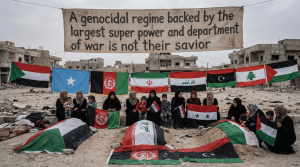
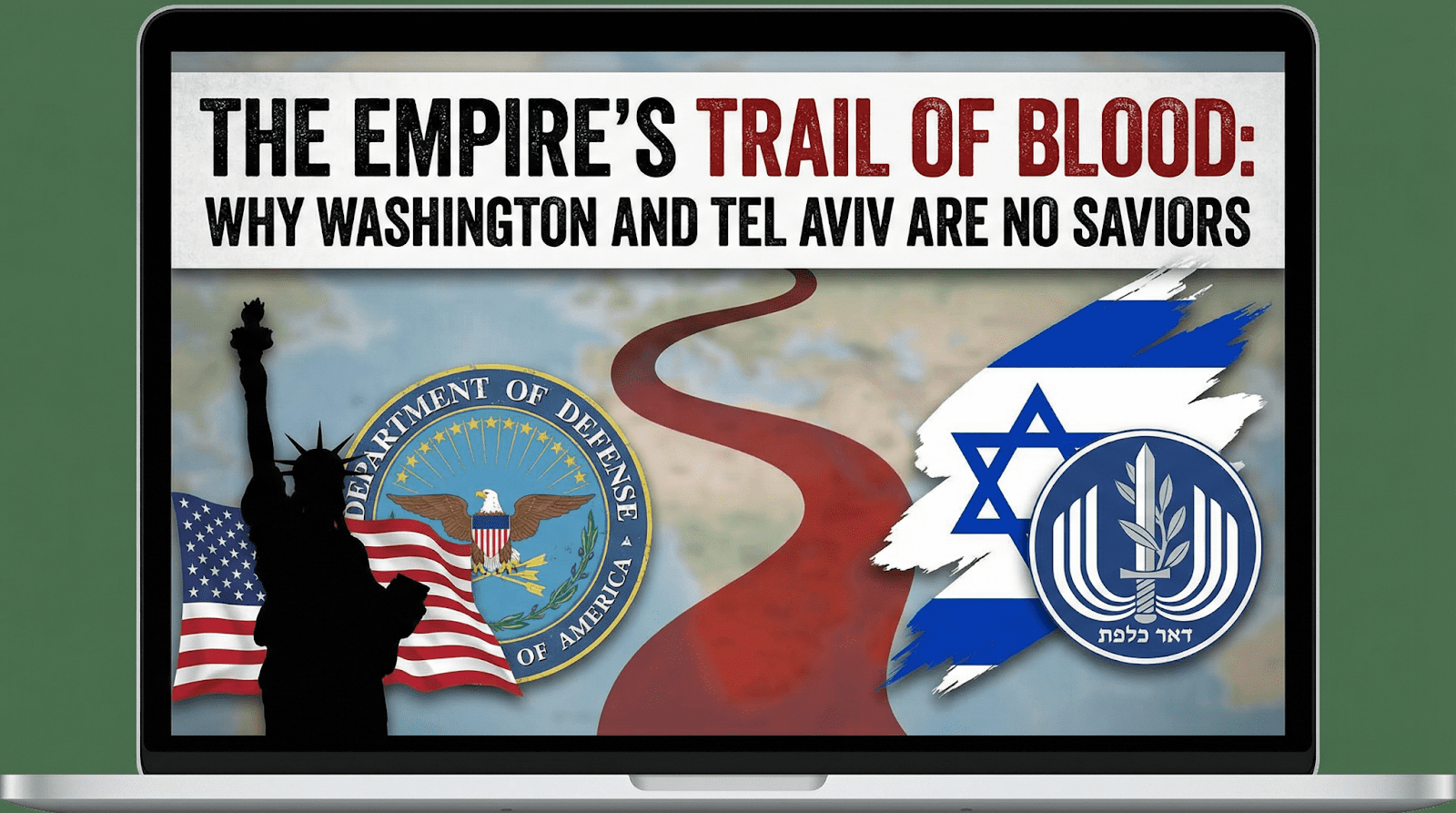
A genocidal regime backed by the largest military superpower on earth and its Department of War is not the savior of Gulf Arab nations, and it is certainly not the liberator of the Iranian people. Anyone who believes otherwise has not been paying attention to the last three decades of American foreign policy and the rivers of blood it has left behind.
For over two years my team and I have been documenting the slaughter of children and innocent civilians across multiple conflicts — from Gaza before and after October 7th, to the Women, Life, Freedom uprising in Iran, to the January 2025 uprising — on our site ParentsPlea.com. We do not trade in abstractions. We publish names, biographies, the testimonies of surviving family members, and documented evidence because the dead deserve more than statistics.
The Numbers Do Not Lie, But Politicians Do
The figures cited by Donald Trump — 45,000 deaths in the course of two days during his April Fools’ address on Iran — are not substantiated by a single credible third-party human rights organization. Not Amnesty International. Not Human Rights Watch. Not the UN Office of the High Commissioner for Human Rights. When a sitting head of state invents casualty figures of that scale without independent verification, it is not a mistake. It is a weapon.
The abuses of the Islamic Republic and the IRGC and Basij against their own people are real and documented. We do not deny them. But Mike Pompeo, MAGA’s former CIA Director, revealed the true intent of Washington when he posted on social media on January 3rd: “Happy New Year to Iranians and Mossad agents beside them.” That single statement was not careless. It was calculated. By publicly crediting a popular grassroots uprising to Mossad intelligence assets, Pompeo handed the Islamic Republic the exact pretext it needed to brand every protester a foreign spy, justify mass arrests, and crush dissent under the banner of national security. Based on video evidence we have reviewed, the IRGC and Basij used this cover aggressively and brutally against peaceful civilians.
Pompeo did not make a mistake. His intent was to ignite division, to inject distrust into a legitimate popular movement, and to serve the interests of Benjamin Netanyahu’s government — which has never wanted a strong, democratic, unified Iran. A strong Iran challenges Israeli regional dominance. A broken, sectarian, bleeding Iran does not.
The United States and its client state Israel are not in the business of Iranian democracy. They are in the business of Iranian fragmentation.
Thirty Years of American Wars: The Evidence
Let us not speak in abstractions. Let us speak in facts. Let us count the bodies that American foreign policy has left across the Middle East and North Africa over the past three decades, because the Gulf states and the Iranian opposition must understand what kind of partner they are being asked to trust.
Afghanistan — The Laboratory of Blowback
The United States did not arrive in Afghanistan in 2001 without a history there. Washington spent the 1980s arming, funding, and ideologically cultivating the Mujahideen to fight the Soviet Union — a project that gave birth to Osama Bin Laden as a CIA-supported asset and laid the foundation for Al-Qaeda. The monster America created came home in September 2001, and the American response was to invade the very country its own policies had destabilized.
The twenty-year occupation of Afghanistan (2001–2021) resulted in the deaths of an estimated 176,000 people according to the Costs of War Project at Brown University — including 46,319 documented Afghan civilians, 69,000 Afghan military and police, and over 51,000 opposition fighters. More than 2.6 million Afghans were displaced externally, with millions more internally. The United States spent $2.3 trillion on this war. When it finally withdrew in August 2021, it left behind the Taliban — in complete control of the country — and an entire generation of Afghans with nothing. The “War on Terror” began and ended with the same regime in Kabul. The only difference was twenty years of death and a collapsed state.
Iraq — The War Built on Fabrications
The 2003 invasion of Iraq was a war crime dressed in the language of liberation. The weapons of mass destruction never existed. The uranium enrichment claims were fabricated. Colin Powell’s presentation to the United Nations was, by his own later admission, a stain on his legacy. Saddam Hussein was a brutal dictator — and the United States knew that well, having supported him throughout the 1980s, including during his use of chemical weapons against Kurdish civilians at Halabja in 1988 when he was still Washington’s ally.
The cost of correcting the monster Washington once armed was paid entirely by the Iraqi people. The Iraq Body Count project documented a minimum of 208,000 violent civilian deaths between 2003 and 2019. The 2006 Lancet study, peer-reviewed and published in one of the world’s most respected medical journals, estimated 654,965 excess deaths attributable to the conflict by that point. The UN estimated 4.7 million Iraqis were displaced — nearly 20 percent of the entire population. The war also directly created the power vacuum that gave rise to ISIS, whose reign of terror across Iraq and Syria produced yet another layer of mass atrocity. Iraq entered 2003 as a functioning, if authoritarian, state. It emerged as a broken nation whose wounds have not closed twenty years later.
Libya — The Promise Betrayed
Muammar Gaddafi was no democrat. But by 2003 he had agreed to dismantle his weapons of mass destruction programs, cooperate with Western intelligence services, and reintegrate Libya into the international community. In exchange, he received implicit assurances of security. In 2011, NATO bombed his country into civil war regardless. The intervention, authorized under the humanitarian cover of UN Resolution 1973, rapidly became a regime-change operation. Gaddafi was hunted and executed in the street.
The 2011 conflict killed an estimated 25,000 to 30,000 Libyans. What followed was not democracy. Libya fractured into rival governments, warlord territories, and militia fiefdoms. It became a transit point for weapons flowing into the Sahel and a staging ground for human trafficking networks exploiting sub-Saharan African migrants. The UN has documented slave markets operating on Libyan soil. Over a decade later Libya remains a failed state with no unified government and no peace. The lesson Gaddafi’s fate taught every government that considered negotiating with Washington was simple: give up your weapons and you are next.
Somalia and Sudan — The Permanent War Zones
Somalia has been in a state of collapse since 1991, compounded by repeated American military interventions including the 1993 Battle of Mogadishu and subsequent drone campaign eras. The ongoing conflict has killed an estimated 500,000 people and created one of the world’s longest-running humanitarian crises. Al-Shabaab — the jihadist group American policy was meant to eradicate — remains in control of large portions of the country.
Sudan carries the weight of two catastrophic conflicts. The Darfur genocide between 2003 and 2010 killed an estimated 300,000 people according to United Nations figures and displaced 2.7 million. The conflict that erupted in April 2023 between the Sudanese Armed Forces and the Rapid Support Forces has since killed tens of thousands more and created what the UN has described as one of the worst displacement crises in the world, with over 10 million people forced from their homes. Neither conflict has attracted the sustained Western attention or accountability that their scale demands. African lives, it appears, are counted differently.
Syria — How a Revolution Became a Graveyard
The Syrian uprising that began in 2011 was a genuine popular demand for dignity and freedom. What it became was a proxy battlefield for every regional and global power with an interest in the outcome. The United States, Saudi Arabia, Qatar, and Turkey armed and funded opposition factions. Iran and Russia backed Assad. ISIS emerged from the chaos. The result was one of the defining humanitarian catastrophes of the twenty-first century.
Over 500,000 Syrians have been killed since 2011 according to the Syrian Observatory for Human Rights. More than 6.8 million Syrians are refugees abroad — the largest refugee population in the world — and an additional 6.7 million are internally displaced. Thirteen million Syrians require humanitarian assistance to survive. The country’s infrastructure — hospitals, schools, water systems — was systematically destroyed. The political settlement that emerged from this destruction has now, elevated — an organization once formally designated as a terrorist group by the United States itself — to head of government in Damascus. This is not liberation. This is managed chaos.
Yemen — The Forgotten War
Yemen is the poorest country in the Arab world. Since 2015 it has been subjected to a Saudi and Emirati-led military coalition — using American weapons, American intelligence, and American logistical support — in a war that has produced what the United Nations has repeatedly described as the world’s worst humanitarian crisis.
By the end of 2021 the UN Development Programme estimated 377,000 deaths attributable to the Yemen conflict, of which roughly 60 percent — over 220,000 people — died from indirect causes: disease, starvation, and the collapse of medical infrastructure. 21.6 million Yemenis — nearly two-thirds of the entire population — depend on humanitarian assistance. Cholera outbreaks have infected millions. Children are dying of malnutrition at a rate the world should not be able to look at without shame. American-manufactured bombs have struck hospitals, weddings, school buses, and funerals. This war is now in its eleventh year. The Gulf states who participate in it are not acting as regional stabilizers. They are co-authors of a massacre underwritten by Washington.
Gaza — The Ongoing Genocide
We have documented this in detail on ParentsPlea.com because the mainstream record remains incomplete and because the dead deserve their names, not just their numbers.
The siege of Gaza did not begin on October 7th 2023. It began in 2007 when Israel imposed a comprehensive land, sea, and air blockade on 2.3 million people — the majority of them children and descendants of refugees from 1948. Before October 7th, multiple Israeli military operations had already killed thousands of Gazan civilians: Cast Lead in 2008–09, Pillar of Defense in 2012, Protective Edge in 2014 which killed over 2,200 Palestinians, the majority civilians, and the 2021 operation which killed 260 more.
Since October 7th 2023, the death toll in Gaza has surpassed 80,000 documented deaths according to the Gaza Ministry of Health — figures cross-referenced and considered reliable by the WHO, the UN, and Lancet. Given the destruction of civil registry infrastructure and the number of bodies still under rubble, the actual toll is almost certainly substantially higher. Over 1.9 million Gazans — nearly the entire population — have been forcibly displaced. The healthcare system has collapsed. Famine is documented and ongoing. These are not the symptoms of a military response to terrorism. These are the symptoms of collective punishment carried out with industrial efficiency and American weaponry.
Lebanon — The Next Chapter Being Written Now
Over 1.2 million Lebanese civilians have been displaced by Israeli military operations that resumed with intensity in 2024. Lebanon, a country still broken by its own decades of civil war and political paralysis, is being systematically dismantled. Israel’s stated goals have expanded beyond any proportionate military objective. What is happening in Lebanon must be understood in the context of what is being planned for the entire region.
Greater Israel Is Not a Conspiracy Theory — It Is a Policy Document
Mike Huckabee, appointed by Donald Trump as United States Ambassador to Israel, has stated openly that he does not believe in a two-state solution and does not use the word “occupation” to describe Israeli control of Palestinian land. This is not an ideological eccentricity. It is the stated position of the American government.
The Zionist vision of Greater Israel — Eretz Yisrael — encompassing historic Palestine, parts of Lebanon, Syria, Jordan, and the Sinai is not a fringe theological notion. It has been articulated explicitly by senior Israeli ministers in the current government. Finance Minister Bezalel Smotrich has presented maps of “Greater Israel” that include Jordan. National Security Minister Itamar Ben-Gvir has called for the expulsion of Arabs from Israel and the occupied territories. These men are not marginal figures. They are in the cabinet.
The Gulf Arab states sheltering under American military umbrellas — the bases, the carrier groups, the arms deals — should understand with absolute clarity: those installations are not there to protect them from Israeli power. They are there to project American power across the region in service of Israeli strategic interests. A weak, fragmented, sectarian Iran serves that project. A unified democratic Iran does not.
To my Iranian friends: the people who fabricate casualty numbers for political effect, who celebrate Mossad alongside popular uprisings, who have spent forty years preventing a stable democratic alternative from emerging in Iran — these people are not your allies. They are the undertakers of your sovereignty, dressed as liberators.
The arc of American engagement in the Middle East and North Africa over three decades is not a record of liberation. It is a record of destabilization, extraction, and managed devastation that has killed well over two million people across Afghanistan, Iraq, Libya, Syria, Yemen, Somalia, Sudan, and Gaza. The superpower that enables all of this is not a candidate for regional stewardship. It is the primary architect of regional ruin.
We document. We bear witness. We will not stop.
— Vahid Razavi ParentsPlea.com | ForeverPeaceNow.com | EthicsInTech.com | MyAWSStory.com